Characteristics and origin of the Iberian pig
The Iberian pig is a breed of pig native to the Iberian Peninsula, from which it gets its name. Therefore, it can only be found in Spain and Portugal. Both countries are the only producers of Iberian ham in the world because only Spaniards and Portuguese have access to such high-quality raw materials.
But, What are the characteristics and origin of the Iberian pig? What makes it so special?
At Enrique Tomás, we will explain why Iberian ham is a globally recognized product and what makes it so incredibly delicious.
Origin and Particularities of the Iberian Pig
Some of the many devoted ham lovers always have the same questions: What are the characteristics and origin of the Iberian pig? Where does it come from? What are Iberian pigs like?
At Enrique Tomás, we will try to answer the most common questions:
What Animal Does the Iberian Pig Descend From?
There is no one-hundred-percent reliable data explaining the family tree of the Iberian pig, so it is not known for sure how this species originated. However, different specialists suggest that it contains genetic material from three subspecies: the European wild boar, the Mediterranean wild boar, and the Asian wild boar.
Where Can We Find Iberian Pigs?
They are located in some inland Spanish areas such as the northern part of Andalusia, Cáceres, Badajoz, Salamanca, Toledo, and Ciudad Real, and in some Portuguese regions, such as Algarve and Alentejo. It should be noted that Iberian pigs are all those that have a purity of breed equal to or greater than 50%, which means that at least one of their parents is also of Iberian breed. Interestingly, the non-Iberian breed most commonly crossed with this animal is the North American Duroc pig.
What Do Iberian Pigs Look Like?
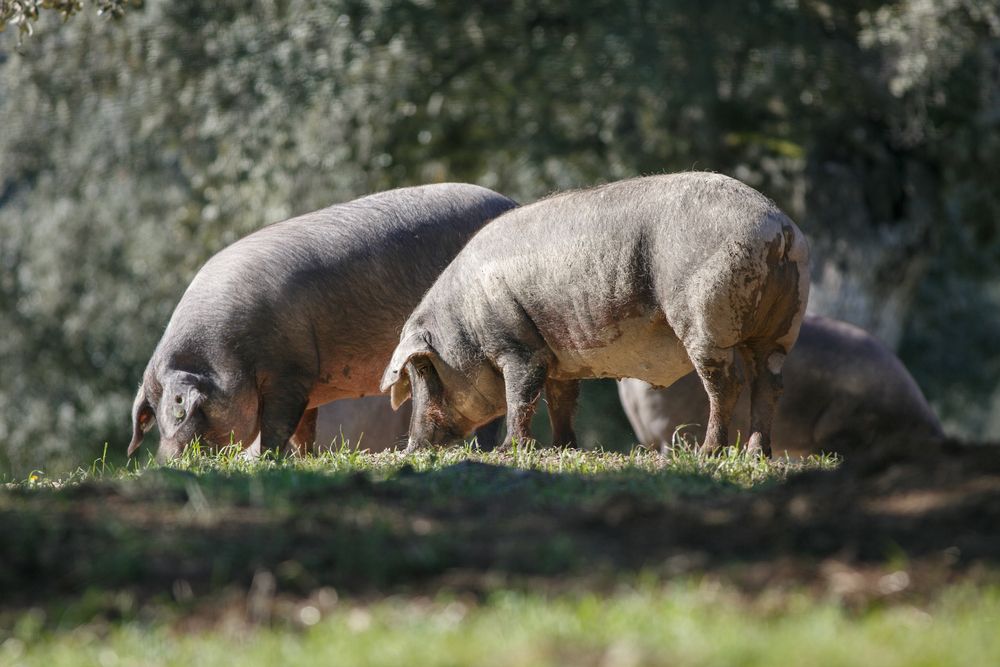
They are medium-sized, dark-colored, and have short hair. Their snout is long, and their legs are slender, long, strong, and more stylized than those of white pigs. The hooves are usually black, which often leads to the term "black hoof ham," but in reality, it's the hoof that is black; to make the leg black, we would have to paint it. It should be noted that hooves are not always black, although it is true that they generally have this color.
Why Is Iberian Meat So Good?
One of the most important characteristics, and what truly makes their meat delicious, is the way Iberian pigs infiltrate fat into their muscles. Iberian pigs filter fat in such a way that their ham is juicier, more aromatic, and has a more delightful texture.
How Are They Fed?
Contrary to popular belief, hams obtained from Iberian pigs fed with acorns have not eaten acorns exclusively. Like humans, pigs need many nutrients, and obviously, these cannot be obtained solely from acorns.
When they are born and until they reach 100 kilograms, all Iberian pigs are fed with feed enriched with vitamins and minerals to ensure that they are healthy and strong. However, when they reach this weight, two things can happen: they either undergo the "montanera" or continue a feed-based diet.
Pigs that go through the "montanera" will eat everything they find in the dehesa, from cork oaks and chestnuts to acorns that have fallen from the trees, as well as grass. On the other hand, those raised on feed will only eat feed. The feeding method depends on the number of acorn-fed or feed-fed Iberian hams and shoulders the producer wants to obtain.
Lastly, it should be noted that, unlike white pigs, the meat of Iberian pigs does improve when they undergo the "montanera". White pigs do not have the ability to filter fat, so even if they undergo the "montanera," their meat will not be different if they are fed this way.
Is the Curing Process the Same as for White Pigs?
Yes, the process is the same, but it takes longer. The curing period for Iberian ham ranges from 18 to 38 months, depending on whether it has been fed with feed or acorns. In contrast, white pigs only require a minimum of one year and a maximum of 30 months. The difference, as you can see, is significant.
How Many Pigs Are Usually in a Litter?
Normally, each female Iberian pig has between four and six piglets when giving birth. When we say a pig is 50% Iberian, it means it comes from an Iberian female crossed with a male of another breed, with the Iberian always being the mother, and the father may or may not be Iberian.
In summary, there are many aspects that make the Iberian pig unique, and therefore, the ham obtained from it is also unique.
Enjoy it whenever you can because it's delicious!